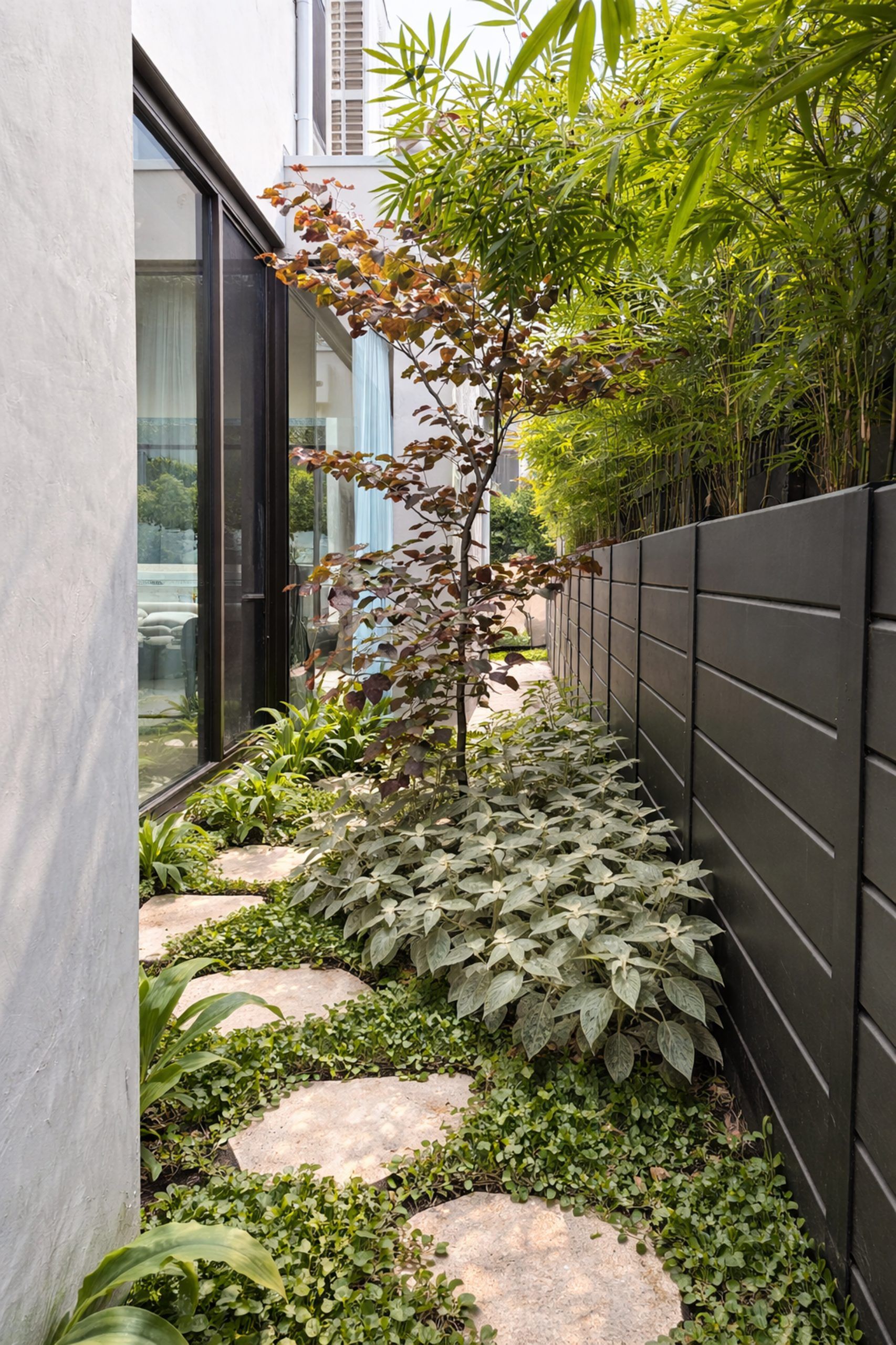

The interplay of garden layers: Canopy, Midstory and Understory
At its most resolved, a garden is a sequence of layers each one working in quiet dialogue with the next. The interplay between canopy, midstory, and understory is not simply a planting strategy; it is a way of shaping atmosphere and grounding a landscape within its broader context.
Canopy as Framework
“The canopy establishes the primary structure of a landscape. It is about positioning trees with intent to define space, control light, and anchor the composition,” says Nathan Burkett, Director of NBLA.
A considered canopy tempers the Australian climate, filtering harsh light into something softer and more usable. It creates rooms without walls, offering both openness and enclosure. In this layer, restraint is critical. Fewer trees, placed well, will always outperform density.
Materiality matters. Trunks, branching habits, and seasonal change contribute as much to the experience as foliage. The canopy is read not only from below, but also as part of the broader landscape, framing views, connecting to horizon lines, and establishing scale.
Midstory as Mediator
The midstory is often used to compress and release space. Taller shrubs and small trees can narrow a pathway, heightening anticipation, before opening into a more expansive area. They provide a level of immersion that the canopy alone cannot achieve.
Planting within the midstory is deliberately restrained, favouring repetition and tonal consistency over variety. Texture and form are prioritised over overt colour, allowing the landscape to feel cohesive rather than ornamental.
The midstory also carries much of the garden’s functionality, screening, buffering, and shaping microclimates, yet it does so without drawing undue attention to itself.
Understory as Grounded Detail
The understory is where the landscape meets the ground, where detail is resolved and the tactile experience is most immediate. It is not an afterthought, but a critical layer that reinforces the overall composition.
Here, planting is often simplified into broad drifts or fields, allowing texture and movement to read clearly. The aim is not complexity for its own sake, but clarity. Repetition creates rhythm; restraint creates calm.
In the Australian context, the understory must also perform. It stabilises soil, manages moisture, and responds to seasonal extremes. Species are selected not only for their visual qualities, but for their ability to endure and contribute to a resilient system.
The Dialogue Between Layers
The success of a layered landscape lies in the relationships between these elements. Light is filtered and modulated as it moves downward. Shadows shift across surfaces. Openings in one layer reveal or conceal another.
There is an intentional looseness to how these layers meet, edges are softened, thresholds are blurred. The goal is not rigid hierarchy, but a sense of continuity. Negative space is as important as planting. Moments of pause, gravel planes, open lawns, or still water allow the layers to breathe and the composition to be understood.
“A layered approach demands patience and clarity. It requires considering how the landscape will evolve, not just how it appears on completion,” explains Nathan. With this approach, the garden is not a collection of plants, but a composed environment. The interplay of canopy, midstory, and understory becomes a quiet choreography.